On Jumping

What’s the deal with jumping?

I’m a good jumper. Seriously, I have photographic evidence. For a stocky, only slightly taller than average dude, I can jump. But, it feels like jumping can be so complicated.

The Pointer Sisters want you to jump for their love.

You need to jump for joy.

When some people tell you to jump, you can only ask “How high?”

You can jump for sport, be it broad, long, high, or triple.

Apparently some guy named Jack flashed you while he jumped.

Originally, Superman couldn’t fly; he just jumped long distances. Seriously, look it up.

Dead cars really need a jump.

Jumping is really the only thing you can do productive in a potato sack.

If you jump, you then have the right to jive.

Trampolines exist only to be jumped on.

Hurdles exist only to be jumped over.

Rings of fire exist only to be jumped through. By sad circus animals.

If you get more than one guy named Jack to jump, you are now exercising.

For a thrill, add a bungee to your jump.

Diving is just fancy jumping into water.

Some newlyweds jump a broom.

Some crazies jump out of planes when they don’t have to.

You can jump with a rope.

Ski jumpers wear cool goggles, helmets, and onesies.

Line jumping, however, is not a sport at most theme parks.

If you want to begin immediately, you need a jump start.

Join in and jump on a band wagon.

Old cops pretend to be young on #21 Jump Street.

Bad television shows jump sharks.

Bela Karolyi holds you in his arms when your jump goes badly.

Basketball players jump for jump balls, take jump shots, and come to jump stops.

Seriously, it’s exhausting. For the rest of the day, we can all take it easy. Just don’t forget to look before you leap.

On Granite Countertops

Almost five years ago, hubby and I embarked on a true rite of passage for couples: buying a home. After months of looking at overpriced, underwhelming homes, we discovered a new town home development in the District. It was in our price range, on the Metro line, and met all our needs. We were excited.

After signing the contract with the builder, we spent hours discussing all of the available options. We visited the builder’s amenities showroom often, discussing which upgraded carpet would best suit our lifestyle and what tile combinations would make our showers even more effective. An upgrade that was a “must have” was granite kitchen countertops. It wasn’t even up for debate, and I fell in love with a particular sample. It went well with the cabinets and hardwood floors we wanted, and I just knew the hint of red streaking through our countertops would make our home the envy of the entire neighborhood. Neighbors would be talking about our home and how we aced our option choices for years to come. Hell, Architectural Digest would probably want to talk.

After we moved in, I kept that countertop gleaming. Four years on, I walk past the countertop without a thought. It’s a perfectly fine, functional surface. I even like it, but my fevered enthusiasm has long since waned. And I know that it’s not just that I’m used to this countertop. I know that, deep down, I’ll never be that excited again. It’s like the great love between me and countertops wasn’t meant to be.

It seems like there is a great disconnect between the things we talk about bringing us happiness and the things that actually bring us happiness. We spend so much mental and emotional energy considering the next widget and how it will better our lives. We do research. We shop around. We anticipate. But imagine how odd it would be if we went shopping for the things that we all know actually do bring us happiness. Imagine walking into a showroom and asking the saleswoman, “Could you show me your section for awesome moments with friends? Where can I buy the quiet moment on vacation when I realize I’ve learned something new? Do you have a clearance rack for hugs and shoulders to cry on? Any sales on confronting my fears?”

Consumerism isn’t bad. We do buy things that genuinely make us happy, like great books and food, just to name two. We would probably all be better off, though, if we changed how we spoke about happiness and our attitudes towards the latest and greatest bauble. It’s so easy to focus on things, but I’m pretty sure happiness comes from a focus on experiences.

We can still buy that amazing granite, but it should only take an investment of cash, not our hopes for self-fulfillment.

On the Danger of Terrariums

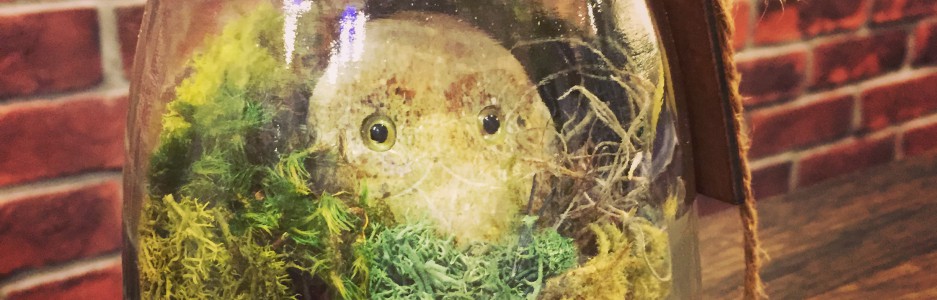
A few years ago, I became fascinated by terrariums. Living in a town home without a yard, space is at a premium, and terrariums are like a travel-size garden in your home. Once you’ve selected your container (typically glass), you can fill it with whatever moves your spirit: river rocks, moss, dirt, sand, shells, feathers, twigs, plants; the list is endless.

The distinguishing feature of terrariums is their miniature effect. Encased in a glass bell can be an entire world. High-end terrarium makers will concoct entire scenes to populate their terrariums, and they are true living works of art.

The miniature worlds created in terrariums give the illusion of total control. The terrarium’s maker controls the contents, the arrangement, the water schedule, the sunlight, the soil mixture, and so on and so on. The maker can create the appearance of perfection, devoid of ugliness or disorder.

What makes for an impressive terrarium produces in us something very different. Indeed, the pursuit of the appearance of perfection tends to only produce pain. Almost a decade ago, my then-partner sat me down one June evening and confessed a nine-month affair. In retrospect, there were a few signs, but really not many. You have to give him credit for his duplicity. When I consider the events of those days, I no longer focus on the unparalleled violation of trust; I focus on my own strange reaction. I didn’t yell. I didn’t rebuke. I didn’t even cry. Like Boxer in Orwell’s “Animal Farm,” I decided the problem could be worked out. I could work harder. I could control everything. In a peculiar, emotionally-retarded reaction, I tried to assuage his guilt.

It can only be said it was a prolonged, stunning repression. It took me almost a year to understand and acknowledge that it was not my problem and that I deserved better. I can only explain the intervening year as an effort to present a picture of perfection, a picture of total control. Such was the power of appearances that an otherwise intelligent, independent person tried to repress the equivalent of a psychic bomb. Why did I not stand up from the couch on that June evening, utter the choicest of curse words, and walk out the door? Shock may explain the first few hours and days. Weeks maybe. But, at some point, I chose the appearance of a perfect happiness over dealing with the greatest pain I ever encountered.

I look back on that time with great sadness, but, through that pain, I learned important lessons. Everything isn’t always perfect. You can’t control it all. Such basic lessons, but we continually screw them up. We badly want things to be just so, and, when life does not give us our desires, some of us engage in acts of psychic self-immolation. Lost, hurting souls that would be well advised to just let go. Just let go.

The danger of terrariums is not selecting the wrong plant or choosing the wrong arrangement. It’s the idea that we can create and control a thing of beauty. That we can achieve perfection. Terrariums need oxygen and water and light and tending. They are not hermetically sealed. And neither should we be. We have to accept imperfection, recognize that we cannot control every facet of our lives, and embrace the sometime ugly realities of life.

At that point, we become even more beautiful.

On My Little Experiment

One week in, I want to say thank you to all of my friends and family that have taken the time to read a few of my entries and give me feedback. I sincerely appreciate it. And, for the reader from Norway that checked out the blog earlier this week, Taak!

I do want to make one point of clarification. Some of my entries have been very personal, such as “On My Grandfathers’ Ghosts.” Others have been funny, such as “On Tight Bike Shorts.” I’m trying to mix it up, but I always hope to have some point.

And, then, there’s “On the Man in the Middle of the Road.” Hubby hated that entry, saying it made me seem superficial and unsympathetic. After my first week, that’s the post of which I am the most proud. I want to try my hand at creative posts like that. For the record, there really was a man in the middle of the road the other day, and many of the elements in the story are factually accurate. I like to think I’m not nearly as superficial and unsympathetic as the narrator in that entry. My point was about that common humanity in us all. Ultimately, the man in the story couldn’t honk at the man, and felt like his values could be seen right through. In the end, he became the second man in the middle of the road. It’s clear that my message didn’t get through, and that fault lies solely with the writer. It’s a great takeaway from this first week.

So, be careful, not every post will be literal. I’m using a little literary license. I hope that keeps things interesting. I know it does for me.

On Tight Bike Shorts

A presidential debate occurred last night. I didn’t watch. I can’t endorse any activity that subjects me and my fellow countrymen to over a year of intense campaigning. Furthermore, I’m a big believer that debates don’t occur among a crowd of people approximately the size of a marching band. If I’m honest, though, those aren’t the reasons I avoided the debate last night. The truth is I can’t watch a debate when no one is willing to tackle the most pressing issue facing our country today: tight bike shorts.

I can’t be the first to notice this unsettling trend. I estimate it’s been growing steadily for over a decade, even since Lance demonstrated how to LiveStrong (or not). At that point, it wasn’t enough to just ride a bike. Everyone was preparing for “The Tour,” and that meant you had to wear the gear. Old Betty Lou hadn’t broken a sweat in fifteen years, but that extra one-tenth of a second she gained on her trip down to the park by wearing aerodynamic clothing was totally worth it. Totally. Rusty had a pretty bad case of gout, but when he suctioned on that yellow jersey, half unzipped, he felt like a champion.

Before long, whole packs of weekend warriors were shimmied into the tightest outfits possible, swearing up and down how it took them to new levels of performance. Special shoes, water packs, energy bars, it was all required. People remember the tight bike shorts, but it was only one part of the ensemble.

As memorable as the tight shorts are, my beef isn’t with their tightness. Rather, it’s with our national obsession with the trappings of achievement, but not achievement itself. It’s all around us. Rippled abs in 3 minutes per day! Earn your degree at home in your pajamas! Learn a foreign language in your spare time! We want it fast, we want it effortless, we want it painless. Only, true success is none of those things, and we all know it down deep.

We tell children they can grow up and be anything they want to be in life. And that sense of optimistic ambition is wonderful, but, maybe, by focusing on the end result, we skip over the truly important parts: the hard work, the sacrifice, the pursuit of excellence. Anyone can slap on a pair of tight bike shorts, some, admittedly, a little easier than others. Few have the discipline to need them.

I don’t begrudge anyone their hobby, a dream of elite athletic performance, or just a desire to avoid unnecessary chafing. All that said, you better put in the miles to earn those bike shorts because, trust me, we’re all watching.

On the Man in the Middle of the Road

Yesterday, there was a man in the middle of the road.

Let me back up. I awoke a little groggy, but I had slept okay, thanks to the premium bedsheets I had recently purchased that swaddled me in a substantial thread count. As I stumbled to my morning shower, I enjoyed the upgraded carpet we selected for the master bedroom, although the cold bathroom tile, brilliant in its gray hues, reminded me that the next house will most definitely have radiant heating in the floor. I perked up in the shower, though, thanks to some pricey shampoo and soap; it’s so worth it in the end.

I glided into my Brooks Brothers dress shirt and suit, only pausing momentarily to select the right purple tie. Stripes? Too square. Plaid? Predictable and worn three weeks ago. Ahh, yes, my lucky purple tie with the subtle but not-too-subtle light blue Brooks Brothers sheep mascot. Perfect!

My steps down to the kitchen fell easily, thanks to the orthotics I’ve been wearing for some time. They would have been expensive, but my comprehensive health insurance took the sting out of that cost. The ping of my spoon against the granite countertop seemed to me to echo off the stainless steel appliances and signal another great, practiced morning.

I threw my gym bag over my shoulder on the way out the door. Located in my office building, the gym is fantastically convenient. And, after the multi-million dollar remodel, it’s taking my workouts to a whole new level. I set the house alarm — I know, I know, but you can never be too safe — and I jumped in the new SUV. Sure, we had spent more than expected, but have you seen the panoramic sunroof? I fired up the satellite radio, GPS, and back-up camera, and eased out of the garage. Hey, there’s Sally and Tom. That stroller must have cost a fortune, but, boy, they sure put in the hours. Good for them!

It was a warm morning, but the vented seats insured my back was cool and my slacks would arrive to work perfectly creased. Traffic’s pretty light, today. I sailed through green light after green light, and some not so green. I really hit my stride once I found just the right radio station. They give you so many choices, it’s actually annoying. I’m sorry, but I don’t need to hear the Top 10 hits from Central America in 1973. I’m sure they’re all wonderful, but, I mean, really.

I had just opened up that beautiful sunroof when I looked up to see him.  What? He’s standing in the middle of the road. He’s just…standing there. What is going on? I slowed down before the crash mitigation safety feature warned me I was about to hit him. The orderly row of town homes slowed down in unison. The trees stood up straight, the other cars bowed out of sight. The radio faded.

He was ten feet in front of my car, and I inhaled as I fixed my eyes upon him squarely. He was leaning slightly to one side, hands swaying around him slowly. Sweat fell down his face, pooling on top of his upper lip. His trousers were dirty but not torn, hiked slightly higher on one leg. Shirt untucked, his torso was formless underneath it. I leaned my head to match the angle of his body, but it didn’t help. It didn’t correct the juxtaposition between his stout, squat body and the street around him. He was leaning slightly. My hand rested comfortably on the lock button.

My eyes met his face, but his eyes did not meet mine. Our eyes were on the same plane, but he looked right through me. Right through me! What the hell was he thinking? Obviously, he wasn’t. This is a busy street, it’s rush hour, you are in the middle of the road, sir! He didn’t move. He didn’t blink. His lips did not form words. He didn’t see me or my expensive car. He just looked right through me. Right through me!

Instinctually, I knew he was high on something. More high than I had ever seen anyone. An unanimated totem to drug use and wasted lives. Still looking right through me, I could only guess he was looking for the next hit. The next medicine for whatever ails him. He’d probably been high for hours. Days, even. Why would someone live like that? Why aren’t you at work?  Why are you making these choices? Don’t you feel a responsibility to contribute to society? Don’t you want vented seats?

I was now the leader of a stalled parade. Horns honked staccatto indictments of the man. Did he not see this? Do you not see that I am important? I have important work to be done. Work for the citizens of this great nation. Serious-minded work. People are counting on me. Wednesday mornings are not leisure time for me, like they obviously are for you. A great nation for me and for you, that’s who I’m helping. Come on! Why are you not moving? I am very sorry you are in this shape, but I cannot help you.

The car three back must be resting his elbows on his horn now. Sir, he’s got important work to do too! What are you looking at?  Can you not see me? Why are you looking right through me?

Okay, now pedestrians are slowing down and looking. The sun had intensified, and I felt the heat through my window and my magnificent panoramic sunroof. More horns now. Hey, sir, you know, this is your fault. I made the right choices. The Right Choices! You did not. Do you know I never skipped a college class? Not once. That’s right. I save my money too. I plan. I plan, and you don’t. Why are you like this? I cannot move forward until you move out of the road, sir.

Can you not hear the horns? They are all blaring now. Why don’t you hear them? I do not need this today. I have a morning meeting. I have allotted enough time for my commute, a morning beverage, some fun banter, and then my meeting. I have this down to the minute, and I’m not changing my smartphone calendar for you sir. I cannot be held responsible for your choices. I made the right choices. Look, I’m sorry. I can’t help you out. You made your choices. How am I responsible for those?

The horns were now constant and profane. It was so damn hot. The man in the middle of the road didn’t move. I’ve been considerate. I’ve been polite. I’ve shown restraint and sophistication. What do want me to do, sir? What are you looking for? Why, how can you look right through me? It’s choices, sir. Choices.

I firmly placed my hand on the middle of the steering wheel, capped so perfectly by the finely polished wood.  I sat up, furrowed my brow, ready to join the chorus.

Yesterday, there were two men in the middle of the road.
On My Grandfathers’ Ghosts

My family has a long, proud tradition of game playing. Board games and cards were staples growing up, and our annual family vacations wouldn’t be complete without a round of cards. Over the years, even our scorecards have developed traditions. As an experienced game and card player, I can tell you that nothing is more frustrating than when a piece or card is missing. Monopoly just isn’t as fun when the Boardwalk property card is missing, especially if you have a little OCD, which is also an enjoyed family trait.

“Missing things” run in families, but they don’t get a lot of attention. Maybe that’s why they’re missing. Or, maybe, good things and bad things get all the attention, and missing things fade away into those forgotten places where socks, discount coupons, and extra keys gather.

My grandfathers were missing. My maternal grandfather died before I was born. My paternal grandfather died five years ago. I can’t say I really knew either of them. It’s not unusual, as accidents, distance, and frayed bonds affect every family. What’s interesting, though, is that, unlike those socks, missing family members still have a presence.

As a younger man, I resembled my maternal grandfather to a degree, and I took an unusual pride in that. I’m certain it was because my connection with him was so tenuous. I didn’t know and still don’t know too much about him, except how fondly my mother thought of him. Sometimes I thought about what it would be like to meet him, to share my life with him, and it’s one of life’s minor cruelties that, instead of knowing him, I only felt the silent power his memory wielded. In some ways, my grandmother’s life froze when he died, set in amber never to change. We pity that, but maybe those who have loved and lost find a strange comfort in that sort of living death.

My grandfather died before therapy and “closure” were in vogue. Maybe that would have helped my family to deal with the pain and move on. They all did in their own way, of course. But, even when we have all been together, one cannot escape the feeling that something that should be there is not.

My paternal grandfather died five years ago, but, in so many ways, he too was more apparition than presence. We never lived close, and his battles with personal demons exacted damage on his family that may have been too much to overcome. I don’t really know. He was always pleasant and kind to me during the once- or twice-a-year visits, but he never seemed particularly interested in being a grandparent. Maybe it was a generational thing. Maybe I just wasn’t as fascinating as I thought I was, but that shocks the conscience to consider. I’ll never know.

The last time I saw him, a strange thing happened. As I walked out the door of his home, he gave me a big hug and followed me out to the porch. As I stepped away to leave, he said, “Next time, bring your friend.” I was not out to him and had never discussed my partner with him, but his meaning was clear. It was an odd intimacy that caught me off guard, a palantir with a vision of a grandfather/grandson relationship that I could not recognize. I said “Okay,” got in my car, and never saw him again.

One doesn’t usually mourn what one never had, and I don’t mourn my grandfathers. But I do feel their presence or, rather, the absence of their presence. I’m left with questions and riddles that do not bother me terribly, but, rather, fascinate me with “What if?” Whenever I hear someone share a story of their grandfather, I immediately think that I cannot reciprocate, that that piece of the puzzle will always be missing in an abstract way for me.

At the end of the day, you can play the board game without the missing token, and you can accept the fact that something isn’t quite right, something isn’t whole. Every family does it in one way or another, it’s part of the human experience. Perhaps the lesson is to not be that missing piece for those that you love, if you can help it. I want to live my life that way, and I’ve made a real effort to be an intentional, loving uncle to my young nephews. I live far away, but they know they are loved. I know I’ll always put in the work to be a positive force in their lives. I have a feeling both of my grandfathers would be proud.

On Being Told To Jump Off A Bridge…With a Heavy Rock Tied Around Your Neck

I’ll never forget the time a resident of my hometown told me I should jump off a bridge with a heavy rock tied around my neck. Okay, he wasn’t talking directly to me. But he did mean me, and he was serious.

In 1999, my small hometown debated an ordinance to prohibit discrimination on the basis of sexual orientation. Predictably, it caused quite the stir. Press conferences were held where the local dry cleaner opined on the Constitution, large assemblies were held in junior high gyms where people prayed and chanted about protecting the family, and some neighbors talked to each other for the last time, to this very day. Three members of the five-member city council supported the measure, and, after multiple meetings and hour upon hour of impassioned pleas from all sides, the council passed the measure. My little town would not discriminate. If you listened to most of the loudest voices, you knew life itself was coming to an end.

All these years later, I don’t remember a lot from those days. Flashes here and there. With unfettered clarity, however, I recall sitting in my junior high school auditorium one night as a large man clad in camouflage sauntered to the microphone to share his views on the nondiscrimination ordinance. Spoiler: he wasn’t a fan. His rousing finale was: “[This town] would be a better place if all the homosexuals here would tie heavy rocks around their necks and jump off the bridge.” At the time, the violent sincerity of his words made the biggest impression. Now, I’m haunted by the fact that I cannot recall him being rebuked or denounced. I can’t recall boos or hisses or gasps or any other reaction.  Maybe every one of the hundreds gathered was in shock. Maybe lots agreed with him but didn’t have the guts to unsheathe their prejudice quite so proudly.

I know the man was an idiot. I knew it at the time. But I still remember his words. I thought of them the day I graduated law school. I thought of them the day I was married. I thought of them every time I came home for the holidays. It’s not post-traumatic stress. It’s how you know some people truly, deeply, greatly, wonderfully hate you for no other reason than who you are.

It’s a different time now, but I’ll never forget my camouflaged friend.  If hubby and I have a large wedding ceremony one day, I already know my toast. After thanking so many wonderful people for being in my life, I’ll share this story. How, to come from sitting in your junior high school and being told, in effect, you are worthless, to being married, having a family and amazing career, living openly and honestly, well, it doesn’t get any better than that. And I’ll mean every single word.

My hometown quickly repealed the nondiscrimination ordinance when new commissioners were elected. Families were spared the evil of equality, the “right” values prevailed, and morality was maintained. But I didn’t jump. I didn’t jump.

On Human Nature

Philosopher Thomas Hobbes held pride and vanity, and the will to dominate, to be basic and original impulses of human nature, which accounts in part for why the State of Nature is a State of War. Jean-Jacques Rousseau denies this, attributing these propensities to society. For Rousseau, in the primitive State of nature, people are moved by their nature needs (food, shelter, sex), guided by self-love, and restrained by natural compassion.

When considering the dueling conceptions of human nature, my mind immediately went to the ring of Gyges myth Glaucon challenges Socrates with in Plato’s Republic. The point is: if a man found a magic ring that rendered him invisible, what would he do? Glaucon’s implied answer is “much mischief.” Perhaps Rousseau would respond that, yes, a man would do mischief, but only because the forces of society had so misshapen his character as to favor mischief. It appears to be an impossible thought experiment, for none of us can divorce ourselves from the state, and, thus, we cannot imagine what the “true” state of nature is like and what is the true state of nature for the human animal.

What is really at stake in these disputes about human nature is the prospect for social change, according to philosopher John Rawls, and he makes a lot of sense. We find echoes of that question in the current political debates, for the extent to which you believe social change possible shapes your views on the appropriateness of the size (and activism) of the state.

It is easy to be too literal with Hobbes, Locke, or Rousseau, and, in the process, get lost in the specifics of their contract theories. What is important, it seems to me, is to understand that, by describing the state of nature, the various philosophers are setting in motion the antecedent conditions for their theories on the proper form and functioning of government. For example, if, like Hobbes, the background nature of man is nastiness and brutishness, then a political philosophy wherein one should accept any sovereign because it is preferable to the State of Nature (i.e., State of War) seems reasonable, to a degree. But, if like Locke or Rousseau, you define man’s pre-state nature to be more positive, pleasant, kind, it would seem crazy to accept any old sovereign.

It is interesting to consider that, when considering the form and function of the state, our consideration is not primarily focused on the state but, rather, on the nature of man. How you topple that first domino impacts the rest of the analysis, does it not?

On the Apple Watch

I’ve worn the Apple Watch for three months now. It’s an amazing piece of technology. Sleek. Comfortable. It even tells time! Critics focus on the battery life, the price, and the lack of a true need for the device. What holds the device back is none of those things, though. Rather, the watch’s inability to independently access the Internet is its Achilles heel, and that weakness will prevent it from becoming the next must have, mega-hit product.

Smart phones, tablets, and laptops open new worlds for users, or, at least make the known frontiers of the Internet portable and easily accessible.  With the ability to surf the web, one’s phone, tablet, or laptop is ever-changing and always holds the promise of being more than it already is. The Apple Watch doesn’t enjoy that same promise. At least not yet. The small screen and resulting lack of a keyboard limit a user to Siri and widget-like information retrieval. Nice. Helpful. Impressive, even. But you’re still constrained. The Apple Watch brings the world to us, but only in predetermined packets. How Apples solves this riddle is unclear, but, until it does so, any expectations that the Apple Watch will operate on the same tier as products like the iPhone and iPad are misplaced.

More important than any shortcoming, though, the Apple Watch’s weakness may be more a statement about our changing expectations of technology since the arrival of the mobile Internet. The upper limit is no longer to make tasks more convenient; rather, the new goalpost is to give the user easy access to the whole of human knowledge. That’s a tall order. Maybe we need to content ourselves with the humbling fact that, for now, it’s just a great watch. To get the whole of human knowledge in an easy accessible form, I guess I’ll just have to reach into my pocket.